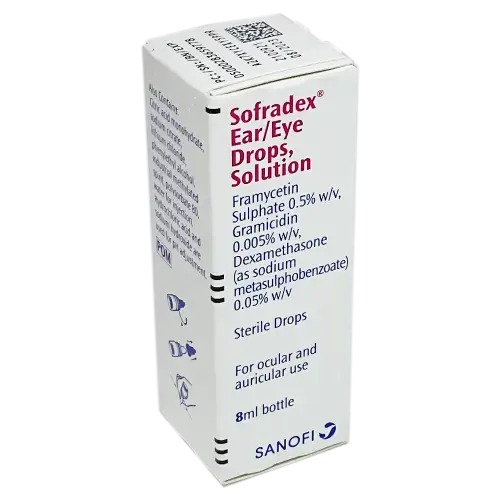
Sofradex Ear/Eye Drops: Antibiotic and Steroid Drops for Ear and Eye Inflammation
Sofradex is a prescription-only medicine that treats infection and inflammation together. Each drop contains two antibiotics, framycetin sulphate 0.5% and gramicidin 0.005%, and the corticosteroid dexamethasone 0.05%, in a sterile, clear, colourless solution. It is licensed in the UK for otitis externa (infection and inflammation of the outer ear canal) and for the short-term treatment of inflamed eyes when protection against bacterial infection is also needed.
Sofradex is often supplied as an alternative to Betnesol-N drops, which pair a similar antibiotic (neomycin) with a steroid (betamethasone) and are frequently out of stock. Both are drops that can be used in the ear or the eye, and a prescriber can usually switch between them when one is unavailable.
We supply Sofradex in an 8ml dropper bottle, which is enough for a full course. Sofradex was a Sanofi brand for many years and is now licensed to Neon Healthcare; the pack you receive may carry either company's name and contains the same formulation.
Understanding outer ear infections (otitis externa)
Otitis externa is inflammation of the skin lining the ear canal, usually with a bacterial infection on top. It is sometimes called "swimmer's ear" because trapped water is a common trigger, but it also follows:
- scratching or cleaning the ear with cotton buds, fingernails or hair grips
- eczema, psoriasis or seborrhoeic dermatitis affecting the ear canal
- wearing earplugs, earbuds or hearing aids for long periods
- hot, humid weather and sweating
- a build-up of wax or debris that keeps the canal moist
Typical symptoms are itching, pain (often worse when the ear is pulled or when chewing), redness and swelling of the canal, discharge, a blocked feeling and muffled hearing. Most cases clear within a week or two with the right drops, keeping the ear dry and avoiding further scratching.
Understanding inflamed and infected eyes
The eye becomes inflamed when the conjunctiva (the thin membrane over the white of the eye and inside the eyelids) or the eyelid margins react to infection, allergy or irritation. Signs include redness, soreness, swelling, watering and a sticky or crusty discharge, particularly on waking.
A steroid and antibiotic combination such as Sofradex is only appropriate for eye inflammation once a prescriber is satisfied that the cause is not a virus or a fungus, because a steroid can make those infections worse. It is never used for a red eye whose cause has not been diagnosed. Our prescribers will ask detailed questions about your eye symptoms and will direct you to an in-person examination whenever that is the safer route.
What is Sofradex?
Sofradex Ear/Eye Drops, Solution contains three active ingredients:
- Framycetin sulphate 0.5% w/v, an aminoglycoside antibiotic
- Gramicidin 0.005% w/v, a polypeptide antibiotic
- Dexamethasone 0.05% w/v (as dexamethasone sodium metasulphobenzoate), a corticosteroid
The other ingredients are citric acid monohydrate, sodium citrate, lithium chloride, phenylethyl alcohol, industrial methylated spirit, polysorbate 80 and water for injections, with sodium hydroxide and hydrochloric acid to adjust the pH. Sofradex is a prescription-only medicine (POM) in the UK; the marketing authorisation holder is Neon Healthcare Ltd (PL 45043/0115).
How does Sofradex work?
The three ingredients tackle the two parts of the problem, the infection and the inflammation, at the same time:
- Framycetin has a spectrum of activity similar to neomycin. It kills Staphylococcus aureus and most of the clinically important Gram-negative bacteria that infect the ear canal and the surface of the eye.
- Gramicidin is active against many Gram-positive bacteria, broadening the antibacterial cover.
- Dexamethasone is a potent synthetic glucocorticoid. Applied locally it damps down the inflammatory response, so redness, swelling, itching and soreness settle quickly while the antibiotics clear the infection.
Because the drops act where they are placed, very little medicine reaches the rest of the body when they are used as directed for a short course.
What is Sofradex used for?
In the ear, Sofradex is licensed for otitis externa, infection and inflammation of the outer ear canal.
In the eye, Sofradex is licensed for the short-term treatment of steroid-responsive inflammation when antibiotic cover is also required, after fungal and viral causes have been excluded by the prescriber.
Sofradex is not suitable for middle-ear infections behind an intact eardrum (otitis media), for ears with a perforated eardrum or a grommet, for viral or fungal infections, or for an undiagnosed red or painful eye.
Sofradex dosage
Sofradex is used at the same dose by adults, older people and children. Courses are kept short: the licence says treatment should not go beyond 7 days, and if there is no improvement within that time you should speak to a prescriber rather than continue.
- Ear: two or three drops into the affected ear three or four times a day.
- Eye: one or two drops into the affected eye up to six times a day, or more often only if a prescriber has told you to.
Your prescriber may adjust these directions for your situation; always follow the instructions on your dispensing label.
How to use Sofradex
Ear drops
- Wash your hands and remove the cap.
- Tilt your head to one side so the affected ear faces upwards.
- Squeeze two or three drops into the ear canal without letting the dropper tip touch your ear.
- Stay with the ear facing upwards for a few minutes so the drops run down the canal.
- Wipe away any excess with a clean tissue and replace the cap straight away.
Eye drops
- Wash your hands and remove the cap.
- Tilt your head back and gently pull down the lower eyelid.
- Squeeze one or two drops inside the lower lid without touching the eye or lashes with the bottle.
- Close your eye for a moment.
- Wipe away any excess with a clean tissue and replace the cap straight away.
If you forget a dose, use it as soon as you remember unless the next dose is almost due, in which case skip the missed dose. Never use a double dose to make up for a forgotten one. Keep using the drops for the course your prescriber has set, even once the ear or eye feels better, so the infection does not return. If you have a hearing aid, leave it out while the ear is being treated where you can.
The bottle is sterile when sealed. Write the date you open it on the carton and throw it away 28 days after opening, even if some solution is left.
Sofradex compared with Betnesol-N and Otomize
- Betnesol-N drops contain betamethasone 0.1% (a steroid) and neomycin 0.5% (an aminoglycoside antibiotic closely related to framycetin). Like Sofradex they can be used in the ear or the eye, so Sofradex is the usual replacement when Betnesol-N is out of stock. Sofradex adds a second antibiotic, gramicidin, and uses dexamethasone as its steroid.
- Otomize is an ear spray containing dexamethasone, neomycin and acetic acid. It is licensed for ears only and must never be used in the eyes, so it is not an option for eye inflammation.
Our prescribers choose between them on the basis of where the problem is, what has been tried before, any allergies and current stock.
Who should not use Sofradex?
Do not use Sofradex if you:
- are allergic to framycetin, neomycin or other aminoglycoside antibiotics, to gramicidin, to dexamethasone or to any of the other ingredients
- have an ear or eye infection caused by a virus or a fungus
- have an untreated pus-forming (purulent) infection of the ear or eye, which a steroid can mask or make worse
Do not use the drops in your eye if you have glaucoma, an eye infection caused by tuberculosis, a herpes simplex (dendritic) ulcer or other viral infection of the cornea, pus in the eye, or a red, painful or swollen eye whose cause has not been diagnosed.
Do not use the drops in your ear if you have, or might have, a perforated eardrum or a grommet, because the antibiotic can reach the inner ear and damage hearing.
Tell your clinician before using Sofradex if you
- are pregnant, think you may be pregnant, are trying for a baby or are breast-feeding. Sofradex is used in pregnancy only when the expected benefit outweighs the possible risks, which include harm to the baby's hearing from aminoglycoside antibiotics
- have ever had hearing damage, ringing in the ears or balance problems caused by a medicine, or a family member has
- know or suspect you have a mitochondrial disorder, which can increase the risk of aminoglycoside hearing loss
- have kidney or liver problems, which make hearing damage from aminoglycosides more likely
- take ritonavir, cobicistat or other medicines for HIV, or any strong CYP3A inhibitor, because they can increase the effects of the steroid
- have previously had raised eye pressure, glaucoma or cataracts, or are being treated with steroid eye drops or steroid tablets
- are treating a child. Children can use Sofradex, but prolonged courses in babies and young children carry a risk of hearing damage and of steroid absorption, so courses are kept short and reviewed
Sofradex side effects
Most people use Sofradex for a few days without any problems. The frequency of the following effects cannot be estimated from the available data:
- Irritation at the site: burning, stinging, itching, redness or a rash around the eye or ear, usually a delayed allergic reaction to one of the ingredients. Stop using the drops and seek advice if this happens.
- Blurred vision straight after putting drops in the eye, which normally clears within minutes.
- Raised pressure in the eye (glaucoma), which with prolonged use can damage the optic nerve and affect vision, including causing blind spots.
- Cataract (cloudy, fuzzy vision, haloes around lights or trouble seeing at night) after intensive or prolonged steroid use.
- Thinning of the cornea or sclera in people who already have conditions that thin the eye wall.
- Hearing damage. Aminoglycosides can cause partial or total deafness, which may be irreversible, if they reach the inner ear. This is why the drops must not be used with a perforated eardrum and why courses are kept short, particularly in small children.
- Steroid effects elsewhere in the body, which are unlikely with a 7-day course but can follow long-term, intensive use, especially in children.
Stop using Sofradex and see a doctor as soon as possible if you develop a rash or swelling around the eyes or ears, problems focusing or a blind spot, cloudy or fuzzy eyesight, haloes around lights, or a sudden change in your hearing.
Suspected side effects can be reported to the MHRA through the Yellow Card Scheme, online or via the Yellow Card app.
Driving and using machines
Your eyesight may be blurred for a short while after using Sofradex in the eye. Do not drive, cycle or use tools or machines until you can see clearly again.
Storing Sofradex
- Store below 25°C. Do not refrigerate or freeze.
- Keep the bottle tightly closed and out of the sight and reach of children.
- Do not use after the expiry date on the carton.
- Discard the bottle 28 days after first opening. Ask your pharmacist how to dispose of medicine you no longer need rather than putting it in household waste or down the sink.
When to seek urgent help
Ear and eye infections are usually straightforward, but some symptoms need to be seen in person the same day. Contact NHS 111, your GP or an urgent treatment centre, or go to A&E, if you have:
- severe ear pain with a fever, vomiting or feeling very unwell
- sudden hearing loss, severe dizziness or a spinning sensation
- swelling, redness or tenderness spreading behind the ear or onto the face or neck
- weakness or drooping on one side of the face
- discharge from the ear that has lasted more than two weeks, or follows a head injury
- severe eye pain, sudden loss of vision, flashing lights or a curtain across your vision
- an eye that cannot tolerate light, an injury, chemical splash or foreign body in the eye
- a painful red eye while wearing contact lenses
How to Buy Sofradex Online from MediHealth Direct
Sofradex is a prescription-only medicine. To order it from MediHealth Direct:
- Complete an online consultation. You will be asked where the problem is, what your symptoms are and how long you have had them, whether you have ever had a perforated eardrum or a grommet, and about your health, allergies and other medicines.
- Clinical review. One of our UK-registered prescribers reviews your answers and decides whether Sofradex is suitable and safe for you. They may message you for more information, or recommend an in-person examination if your ear or eye needs to be looked at before treatment.
- Discreet delivery. Once approved, your medicine is dispensed by our pharmacy and delivered in plain packaging with the patient information leaflet.
If you have been using Betnesol-N and it is out of stock, mention this in your consultation so the prescriber can confirm that Sofradex is the right substitute for you.
Sofradex FAQs
How quickly does Sofradex work?
Itching, soreness and redness usually start to ease within a few days, because the steroid acts on the inflammation while the antibiotics clear the infection. Finish the course your prescriber has set, and speak to a clinician if there is no improvement after 7 days.
Can I use Sofradex in both the ear and the eye?
Yes. Sofradex is licensed for both, which is one reason it is used as a replacement for Betnesol-N. Use a separate bottle for each site if you have been prescribed treatment for both an ear and an eye, and never let the dropper tip touch skin, ear or eye.
Is Sofradex the same as Betnesol-N?
No, but they are close relatives. Both combine an aminoglycoside antibiotic with a steroid in drops that can go in the ear or the eye. Betnesol-N contains neomycin and betamethasone; Sofradex contains framycetin, gramicidin and dexamethasone. If you are allergic to neomycin you are likely to react to framycetin too, so tell us about any previous reaction.
Can I use Sofradex if I have a perforated eardrum or a grommet?
No. The antibiotics in Sofradex can damage hearing if they reach the inner ear, so the drops must not be used when the eardrum is not intact. If you are not sure whether your eardrum is perforated, your ear needs to be examined in person first.
Can I wear contact lenses while using Sofradex?
Leave your lenses out while your eye is inflamed or infected and until you have finished the course, and wear glasses instead. Ask your pharmacist or optician before you start wearing lenses again, and replace any lenses or case that were in use when the problem began.
Is Sofradex suitable for children?
Sofradex can be prescribed for children at the same dose as adults, but courses in babies and young children are kept short and are reviewed, because prolonged use carries a risk of hearing damage and of the steroid being absorbed. Our online assessment covers patients aged 2 and over; younger children should be seen by a GP.
Can I use Sofradex while pregnant or breast-feeding?
Only if a prescriber has decided that the benefit outweighs the possible risks. There is limited safety information in pregnancy, and aminoglycoside antibiotics can affect the unborn baby's hearing. Tell us if you are pregnant, trying for a baby or breast-feeding so the prescriber can advise.
How long can I keep the bottle once it is open?
Twenty-eight days. The solution is sterile when sealed but not once it has been opened, so write the opening date on the carton and discard the bottle after four weeks even if some remains.
Can I buy Sofradex without a prescription?
No. Sofradex is a prescription-only medicine in the UK. It can be supplied only after a prescriber has assessed that it is suitable and safe for you, which is what our online consultation provides.